

© Ivana Martić, MATH+
Author: Mehmet Akif Yıldız
Challenge
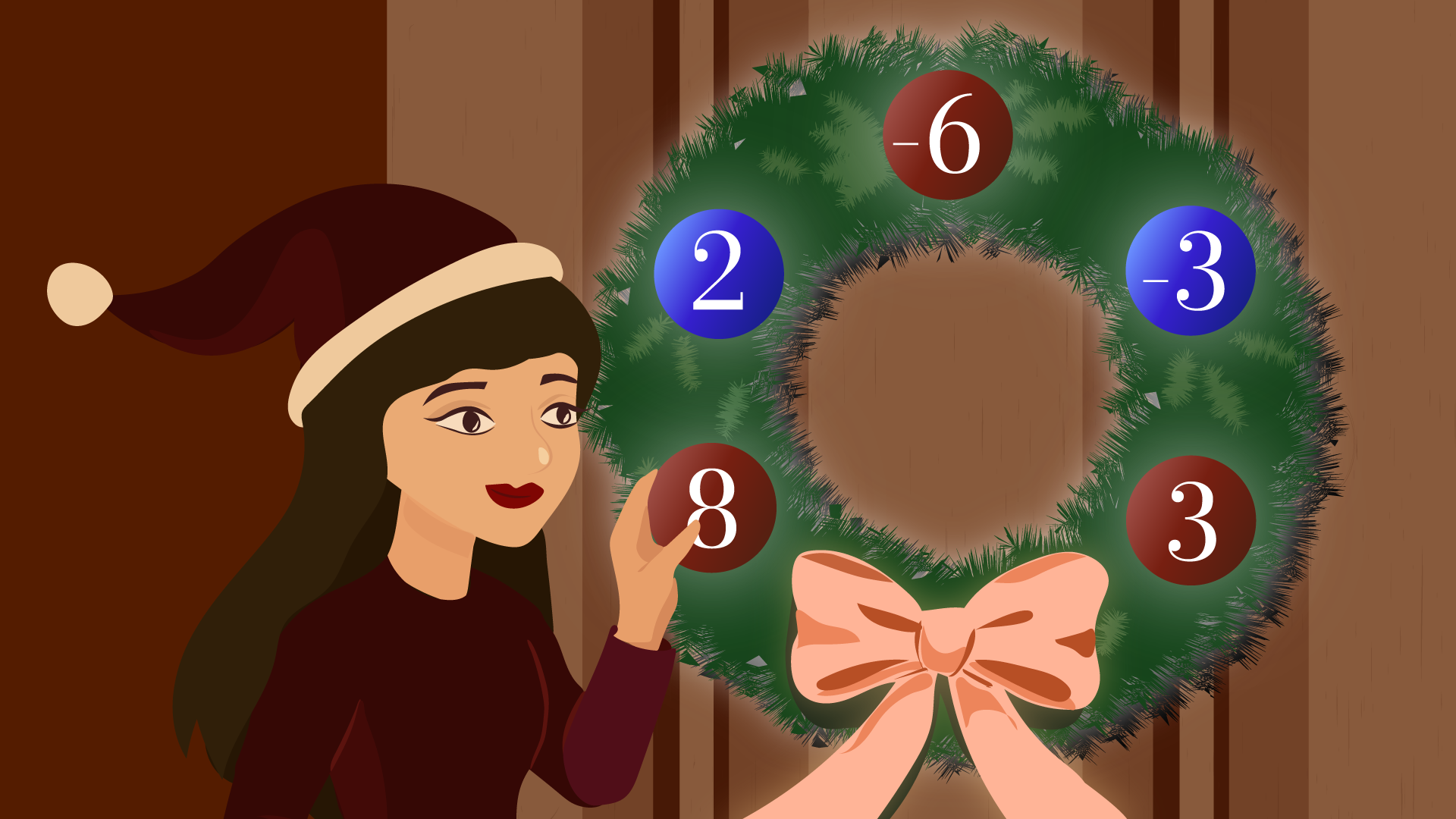
The elves are preparing a magnificent enchanted Christmas wreath to hang above the gate to the reindeer training grounds. Around the wreath, they place a circle of special numbered, magic ornaments. Each ornament carries a number, which is freely chosen by the elves and may be a positive or negative real number — but never zero.
There are two kinds of magic ornaments:
- A blue ornament uses elf magic:
It glows if its number is equal to the sum of the numbers of its two neighbors. - A red ornament uses reindeer magic:
It glows if its number is equal to the product of the numbers of its two neighbors.
To keep the magic flowing properly, blue and red ornaments must strictly alternate around the wreath — blue, red, blue, red … all the way around.
Since it is the year 2025, the elves would have liked to prepare a wreath with 2025 ornaments. However, such a wreath cannot satisfy the alternation of colors around it, so instead they consider wreaths of the two closest feasible sizes, one with n_1 = 2024 ornaments and one with n_2=2026 ornaments, and want to find an arrangement in which every ornament glows. We call such an arrangement a fully glowing arrangement.
For each wreath size, the elves ask themselves:
- Does there exist a fully glowing arrangement?
- If such an arrangement exists: What is the sum of all numbers on the wreath? Is this sum uniquely determined?
Possible answers
- No fully glowing arrangement exists for either n_1 or n_2.
- A fully glowing arrangement exists for exactly one of n_1 and n_2, but the sum is not uniquely determined.
- A fully glowing arrangement exist for both n_1 and n_2; for exactly one of them the sum is uniquely determined and equals 0.
- Fully glowing arrangements exist for both n_1 and n_2; for exactly one of them the sum is uniquely determined and equals 506.5.
- Fully glowing arrangements exist for both n_1 and n_2; for exactly one of them the sum is uniquely determined and equals 759.
- Fully glowing arrangements exist for both n_1 and n_2; for exactly one of them the sum is uniquely determined and equals 759.75.
- Fully glowing arrangements exist for both n_1 and n_2. For both wreath sizes, the sum of the numbers is uniquely determined, and the two sums add up to 0.
- Fully glowing arrangements exist for both n_1 and n_2. For both wreath sizes, the sum of the numbers is uniquely determined, and the two sums add up to 1265.5.
- Fully glowing arrangements exist for both n_1 and n_2. For both wreath sizes, the sum of the numbers is uniquely determined, and the two sums add up to 1266.25.
- Fully glowing arrangements exist for both n_1 and n_2. For both wreath sizes, the sum of the numbers is uniquely determined, and the two sums add up to 1518.75.