

© Julia Nurit Schönnagel, MATH+
Author: Silas Rathke
Challenge
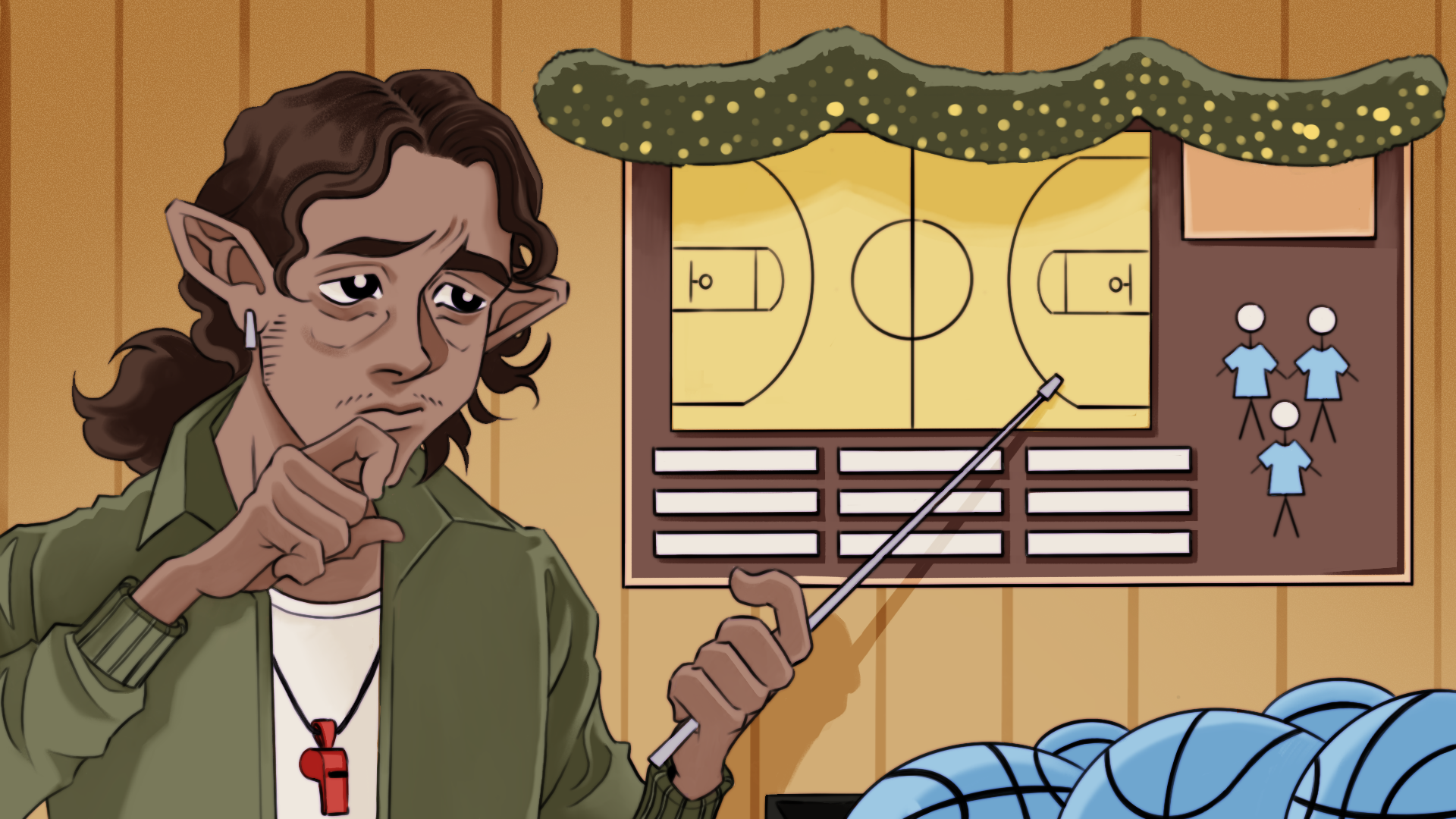
Álex is the coach of an ice basketball team from the North Pole. His team consists of 99 players. For everyone who is not familiar with the local rules of ice basketball in the Christmas Village, the most important ones are listed here:
- During the game, each team has exactly three players on the court.
- During each timeout, each team is allowed to substitute at most one player. Players who have previously participated in the game may be substituted back in.
- Each of the team’s 99 players has to be on the court at least once during a match.
Álex is especially worried about the last rule. He has noticed that each three-player combination on his team either plays very well together or very poorly, and his goal is to ensure that every one of the 99 players appears on the court at least once during a single game without ever having a bad trio on the court.
While thinking about this, he notices the following: If every pair of players could play well with all of the other 97 players, it would be easy to achieve his goal: he could simply make any substitution he wanted and send one player onto the court at a time. However, if every pair of players would form a good trio with exactly one other player, he would have no chance: no matter which trio starts on the court, Alex could not make a substitution without having a bad three-player combination continue playing.
Find the smallest non-negative integer k with the following property: If every pair of players forms a good trio with at least k of the other 97 players, then it is always possible to choose a starting trio and then make a sequence of substitutions so that every one of the 99 players is on the court at least once, and at no time does a bad three-player combination play.
What is the units digit of k?
Remark: Ice basketball games in the Christmas Village are always extremely long and have many timeouts because of the slippery ice. No matter what sequence of substitutions Alex chooses, there will definitely be enough timeouts to carry them all out.
Possible answers:
- 1
- 2
- 3
- 4
- 5
- 6
- 7
- 8
- 9
- 0
You must be logged in to submit your solution and feedback.